Green vs Red Laser Levels: Which Is Right for Your Work?
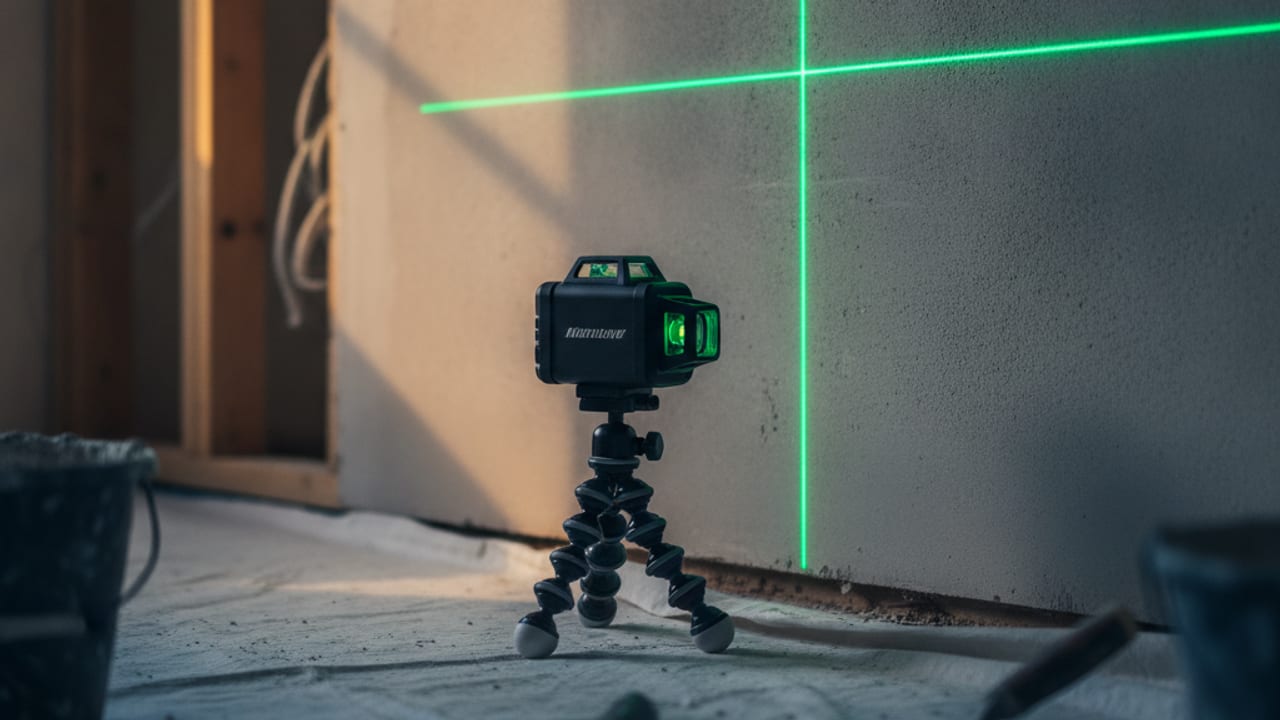
For most people the answer is simple: buy green if the laser earns you money or you work in bright rooms, buy red if you use it occasionally indoors and want to spend less. A green beam appears far brighter to the human eye at the same output power, which makes it usable in daylight-lit rooms where a red line washes out. The trade off is price and battery life.
That one paragraph covers the decision for nine buyers out of ten. The rest of this article explains why green looks brighter in the first place, where red still genuinely makes sense, what the colour choice costs you in batteries and pounds, and the outdoor situation where beam colour matters far less than people think.
Why Green Beams Look So Much Brighter
It is not marketing. The human eye is most sensitive to light in the middle of the visible spectrum, around the green wavelengths near 510 to 532 nanometres. Red laser diodes sit up at 630 to 650 nanometres, right where our sensitivity drops away. The practical result is that a green line of the same output power appears several times brighter to your eye than a red one. Brands often quote "up to four times more visible" and, unusually for tool marketing, that claim lines up with how the physics of human vision works.
On site, the difference shows up exactly where you need it. In a room with big windows on a sunny day, a red cross line can fade to the point where you are shading it with your hand to find it. A green line in the same room stays workable. Tilers striking a datum around a bright extension, kitchen fitters levelling a run of units under task lighting, and anyone working against pale plasterboard will feel the difference within the first hour.
Distance amplifies it. Both colours look fine at two metres. Stretch the line across a six metre open plan room and the green beam keeps a crisp, followable edge while the red one thins out. If your typical job involves larger rooms or full-room setting out with a 360 degree laser, green stops being a luxury and becomes the sensible default.
Where Red Still Makes Sense
Red is not obsolete, and pretending otherwise would cost some readers money for no benefit. A red beam laser is the right buy in three situations.
- Occasional indoor DIY. Hanging shelves, aligning picture frames, fitting a radiator or levelling a single run of cabinets happens in normal domestic lighting at short range. A decent red cross line handles all of it, and the money saved buys a better tripod or a set of decent fixings.
- Dim or first fix environments. In an unlit shell, a loft, a basement or behind closed curtains, red beams are perfectly visible. Electricians doing first fix in unplastered rooms often get on fine with red because the conditions flatter it.
- Tight budgets with honest expectations. The cheapest green lasers cut corners on the parts that matter more than colour: the pendulum, the accuracy and the build. A well made red laser from a reputable brand beats a flimsy green one every time, because a bright line that is 5mm out at the far wall is worse than useless.
That last point deserves emphasis. Beam colour is the most visible spec, but accuracy, self levelling quality and durability decide whether the tool can be trusted. Colour should be the tiebreak between two well made units, not the reason you buy a poorly made one.
Ready to pick a model? We compared six laser levels genuinely worth buying for UK trade and DIY use, from budget cross lines to 3x360 green units.
See the best laser levels for UK tradesThe Real Cost of Going Green: Price and Battery
Green laser diodes are more expensive to make and less electrically efficient than red ones, and both facts reach your pocket. On price, expect a green version of a comparable laser to cost noticeably more than its red sibling, with the gap largest on budget models and narrower at the premium end where green has become standard.
On battery, a green diode draws more current to produce its line, so runtime per charge or per set of batteries is usually shorter. How much shorter varies by model, but it is worth checking two things before you buy: whether the unit runs on a rechargeable pack rather than disposable cells, and whether it can charge from USB. A green 3x360 laser running all three planes will work its battery hard, and a mid job battery swap is exactly the interruption a laser is supposed to eliminate.
One more practical note: green units can be slightly more temperature sensitive, and all line lasers dislike being frozen overnight in a van. Whatever colour you choose, bringing the tool in from the cold before asking it to self level is a habit that pays.
Outdoors, Neither Colour Wins Without a Detector
This is the spec that catches people out. In full daylight, any line laser beam becomes hard to see beyond a few metres, green included. Green buys you a little more usable outdoor range than red, but neither gets you across a driveway on a bright day by eye alone.
The proper answer for outdoor levelling is a detector, sometimes sold as a receiver, which clamps to a levelling staff and picks up the beam electronically. With a compatible laser in pulse mode, a detector extends the working range to 50 metres or more regardless of sunshine. If you set out patios, fencing, groundworks or extensions, choose a laser that is detector compatible and budget for the receiver, which is often sold separately. If you never work outside, ignore outdoor range figures entirely and spend the money on beam quality instead.
The Decision in One Table
| Your situation | Buy | Why |
|---|---|---|
| Daily trade use, lit interiors | Green | Visibility all day in real conditions, less squinting, faster work |
| Full room setting out, larger spaces | Green 3x360 | Line stays crisp at range where red thins out |
| Occasional DIY, normal room lighting | Red | Does the job at short range for less money |
| First fix in unlit shells | Either | Dim conditions flatter red; buy on accuracy and build |
| Regular outdoor levelling | Either + detector | Daylight defeats both colours by eye; the receiver does the work |
We shortlisted the green and red models that actually deliver on accuracy and build quality, with honest trade offs for each.
Read our best laser levels UK guideFrequently Asked Questions
Is a green laser more powerful or more dangerous than a red one?
Consumer and trade line lasers of both colours are sold in the same low power laser classes, typically Class 2, and are safe for normal use. Green looks brighter because your eye is more sensitive to that wavelength, not because the laser is pushing out meaningfully more power. The usual rule still applies to both: never stare into the beam or point it at anyone's eyes.
Do green lasers work outside in sunlight?
Better than red, but not well enough to rely on. By eye, even a bright green line fades within a few metres in full daylight. For genuine outdoor levelling you need a laser with a pulse mode and a compatible detector on a staff, which works to 50 metres or more in any light.
Why is my green laser's battery draining faster than my old red one?
That is normal. Green diodes are less electrically efficient, so they draw more current for the same runtime, and multi line units running several planes at once compound it. Running only the lines you need, rather than all of them, noticeably extends a charge on any 3x360 unit.
Is it worth replacing a working red laser with a green one?
If you use it occasionally indoors, no, keep the red one until it dies. If you use a laser most days, work in bright rooms, or have caught yourself struggling to see the line, the upgrade pays for itself in saved time and fewer misread marks. Trade users who switch rarely go back.