Best Pressure Washers UK 2026: Six Machines That Earn Their Keep
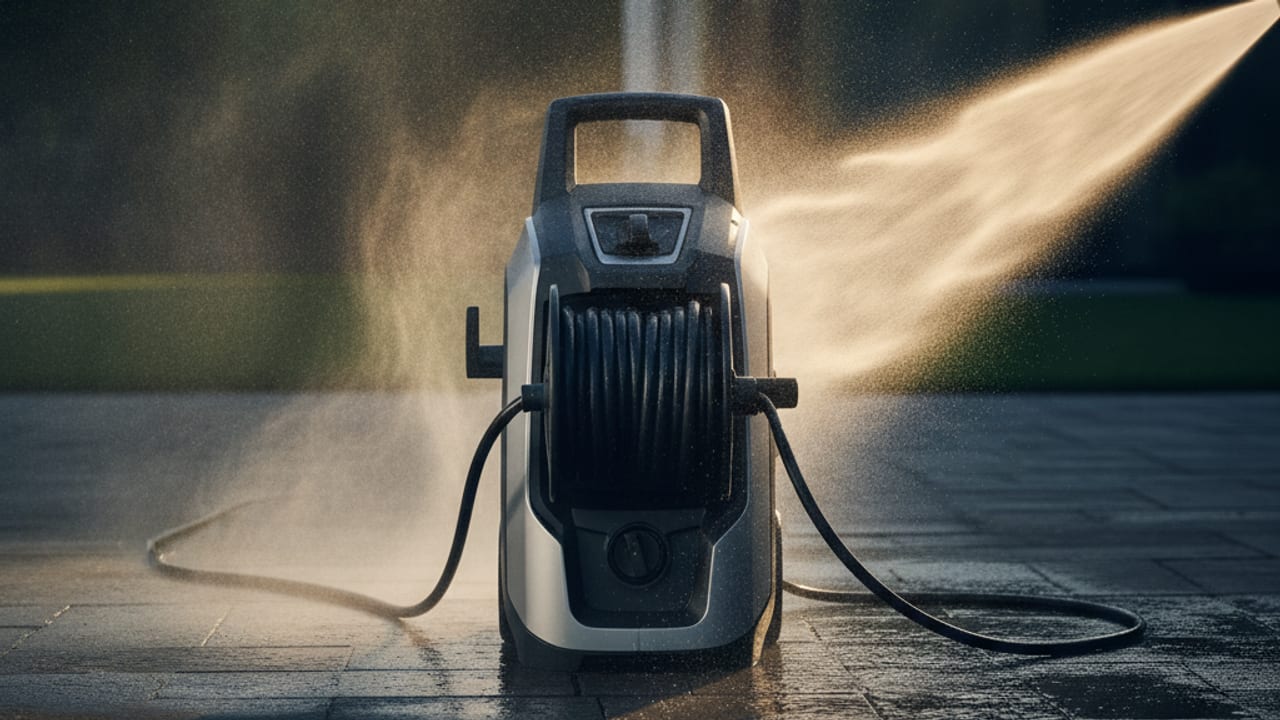
British weather is unkind to hard surfaces. By March, a patio that was pale grey in September has turned green and slippery, block paving has grown a beard of moss, and the wheelie bins are best not discussed. A decent pressure washer reverses all of it in an afternoon, and for anyone in the trades it also handles van wash downs, plant cleaning and end of job tidy ups that would otherwise eat billable hours. The awkward part is choosing one, because the market runs from featherweight machines that struggle with anything worse than a muddy bike up to petrol units that will strip paint if you let them.
We have kept this list to machines where the build quality justifies the outlay. There are lighter, cheaper washers around, and for rinsing garden furniture twice a year they manage, but they typically use small universal motors that run hot and are the reason so many pressure washers end up at the tip after two summers. The machines below all have the motor and pump quality to still be working in five years, which is where the real value sits. Six picks follow, from the default household choice to a petrol unit for work beyond the reach of an extension lead.
The Numbers That Decide Cleaning Speed
Manufacturers shout about bar figures because a big number is easy to print on a box. In practice, three things determine how fast a machine actually cleans and how long it lasts.
- Pressure and flow together, not pressure alone. Bar tells you how hard the water hits; litres per hour tells you how much dirt gets carried away once it is loosened. A machine with a high bar rating but a thin flow feels like cleaning a driveway with a scalpel. For patios, cars and decking, something in the 120 to 135 bar region with 400 litres per hour or better is comfortable. Block paving, render and machinery reward 140 bar upwards paired with a strong flow figure.
- Motor type is the durability story. The quiet giveaway on premium machines is a water cooled induction motor, which runs cooler and vastly outlasts the air cooled universal motors in budget washers. If a machine is noticeably heavy for its size, that is usually the induction motor, and it is a good sign rather than a bad one.
- The accessory ecosystem decides how much you actually use it. A rotary patio cleaning head turns a streaky two hour job into an even twenty minute one, and is honestly worth more than an extra 20 bar. Before committing, check what surface cleaners, foam bottles, drain rods and replacement hoses exist for the brand, and whether spares such as O rings and lances are easy to buy. This is where Karcher and Nilfisk pull clear of the no name brands.
- Mains or petrol is a question about sockets, not power. If every job you do is within cable reach of a plug, buy electric: quieter, lighter, no fuel, no servicing. Petrol is for farms, sites, stables and driveways a long way from the house, where its independence and higher output justify the noise and the maintenance.
All Six Picks at a Glance
| Pick | Best for | Max pressure | Typical price band |
|---|---|---|---|
| Karcher K4 Power Control | Most UK households | ~130 bar | £160 to £230 |
| Karcher K5 Premium | Big areas, regular use | ~145 bar | £280 to £400 |
| Nilfisk Core 140 | Karcher alternative | ~140 bar | £140 to £200 |
| Bosch UniversalAquatak 135 | Compact storage | ~135 bar | £120 to £180 |
| Wilks-USA RX550 | Raw power per pound | very high claimed | £110 to £170 |
| Hyundai HYW3100P2 petrol | Off grid and site work | ~200+ bar | £250 to £340 |
Bands are typical Amazon UK prices at the time of writing, quoted as ranges because prices move often.
Our Six Picks for 2026
Karcher K4 Power Control Pressure Washer
Best for most UK households
The K4 sits at the point in Karcher's range where the machines become long term purchases. It uses a water cooled motor rather than the air cooled unit in the smaller K2 and K3, delivers around 130 bar with a healthy flow, and the Power Control lance lets you dial pressure up and down for the surface you are on, so you can go from blasting paving slabs to rinsing a car door without swapping hardware. What really sells it is everything around the machine: Karcher's patio heads, detergents, extension hoses and spare parts are stocked by nearly every UK retailer, so it never becomes an orphan product. Considerations: it is bulkier than the budget machines and overkill if your entire cleaning workload is one small path, and the supplied hose is on the short side for larger gardens, so budget for an extension. Typical price band is around £160 to £230.
View on Amazon UKKarcher K5 Premium Power Control Pressure Washer
Best for big areas and regular use
Where the K4 is the sensible household machine, the K5 Premium is the one for people who clean often and clean big: long driveways, block paved parking areas, render, a work van every Friday. Pressure climbs to roughly 145 bar with a stronger flow rate, which translates into visibly faster passes over dirty concrete, and the water cooled motor is built for the long sessions that make cheaper machines cut out on thermal protection. The Premium version adds a hose reel, which sounds trivial until you have wrestled ten metres of stiffened high pressure hose back into a box in the rain. Considerations: it is a heavy, bulky unit that wants a proper storage spot, and if your cleaning is occasional and small scale the K4 does the same jobs slightly slower for a lot less money. Typical price band is around £280 to £400.
View on Amazon UKNilfisk Core 140 Pressure Washer
Best alternative to Karcher
Nilfisk is the Danish firm that professional cleaning companies have bought from for decades, and the Core 140 brings that heritage to a domestic machine at a price that undercuts the equivalent Karcher. You get around 140 bar, a well made aluminium pump where many rivals use plastic, and a click in accessory system with its own range of patio cleaners and brushes. Owners tend to praise exactly the things that matter long term: the pump durability and the way the machine keeps its pressure over years of use. Considerations: the accessory range, while decent, is not as widely stocked in UK stores as Karcher's, so you will be ordering attachments online rather than picking them up in a DIY shed, and the hose storage arrangement is more basic than the premium Karchers. Typical price band is around £140 to £200.
View on Amazon UKBosch UniversalAquatak 135 Pressure Washer
Best for compact storage
Plenty of UK homes have nowhere sensible to keep a K5 sized machine, and this is where the UniversalAquatak 135 earns its place. It packs roughly 135 bar into a genuinely compact upright body, comes with a three in one nozzle that covers fan, rotary and pencil jets without carrying spare lances, and it starts and stops smartly with the trigger so it is easy to use in short bursts. It is the machine for a terraced house with a small patio, a car and a set of bins, where cleaning power matters but cupboard space matters just as much. Considerations: the flow rate is behind the bigger Karcher and Nilfisk units so large areas take longer, the fittings are more plastic than metal, and the accessory catalogue is thinner than Karcher's. For frequent heavy use, spend more; for everything else it is a very easy machine to live with. Typical price band is around £120 to £180.
View on Amazon UKWilks-USA RX550 High Power Pressure Washer
Best raw power per pound
Wilks-USA is an Amazon native brand that has carved out a following among UK buyers who want maximum cleaning punch without a premium badge, and the RX550 is its flagship electric machine. The claimed pressure figures are ambitious and best treated as marketing, but the real world result is a machine that hits noticeably harder than similarly priced big brand models, which makes short work of ingrained grime on concrete, stone and machinery. It ships with a generous bundle of lances and nozzles that the premium brands would sell separately. Considerations: the fit and finish is a step below Karcher and Nilfisk, spares support is more limited, and the aggressive output wants respect around soft timber, old pointing and painted surfaces. Buy it for hard standing and heavy dirt rather than delicate work, and it delivers a lot of cleaning for the money. Typical price band is around £110 to £170.
View on Amazon UKHyundai HYW3100P2 Petrol Pressure Washer
Best for off grid and site work
Once the job is a stable yard, a farm building, a long rural driveway or a site cabin with no power, mains machines are out of the conversation and petrol takes over. Hyundai's HYW3100P2 pairs a pull start petrol engine with a pump delivering well over 200 bar, which is a different league of output from any domestic electric unit, and it will run all day anywhere you can carry it. Hyundai's UK operation backs its petrol kit with proper warranty support and a spares network, which matters more on an engine driven machine than on anything else in this list. Considerations: it is loud, heavy and needs the same care as any petrol tool, including fuel management and winter storage, and that much pressure will damage soft surfaces and old mortar joints if you are careless. If your work lives near a socket, buy electric; if it does not, this is the tool. Typical price band is around £250 to £340.
View on Amazon UKWhich One Should You Buy?
Typical UK house with a patio, a car and bins? The Karcher K4 Power Control is the default for a reason: enough power for every routine job, a water cooled motor that lasts, and accessories available everywhere. Add the patio cleaning head and you will wonder why you waited.
Large areas, regular wash downs, or trade use near power? The K5 Premium's extra pressure and flow pay for themselves in time saved, and the Nilfisk Core 140 is the value route to similar performance if the Karcher badge does not matter to you.
No socket where the dirt is? The Hyundai petrol machine is the honest answer, and the only one here that works for farms, stables and remote sites. For everyone else, its power is more than the job needs.
Frequently Asked Questions
How much bar pressure do I actually need?
For cars, garden furniture, decking and general patio cleaning, around 120 to 135 bar with a decent flow rate is comfortably enough. Ingrained dirt on block paving, render cleaning and machinery justify 140 bar and above. More pressure than the surface can take is a liability rather than a bonus, which is why adjustable lances such as Karcher's Power Control system are genuinely useful rather than a gimmick.
Why do cheap pressure washers die so quickly?
Usually the motor. Budget machines use air cooled universal motors that run hot and wear fast, plus plastic pump internals that give up when run dry or left full of water through a frost. Mid range machines and above use water cooled induction motors and metal pump parts, which is most of what you are paying for. Draining the machine before winter and never running it without water supply extends any washer's life considerably.
Is a patio cleaning attachment worth it?
Yes, more than almost any other accessory. A rotary surface cleaner hovers over the slab on a cushion of spray with two spinning jets underneath, cleaning a wide even stripe with no zebra lines and far less mess up your walls and windows. On a full patio or driveway it cuts the job time by well over half compared with a standard lance.
Can a pressure washer damage my patio or car?
It can if misused. Tight pencil jets at close range will gouge soft timber, strip paint, blast the sand out of block paving joints and open up weak mortar. Use a wide fan pattern and sensible distance on anything soft or painted, keep the jet moving, and resand block paving after a deep clean. Cars are fine with a fan nozzle, a foam attachment and distance; they are not fine with a turbo nozzle up close.
Mains or petrol for occasional big jobs?
Stay mains if there is any socket within extension lead reach, and consider hiring a petrol machine for the rare monster job rather than owning one. Petrol earns its ownership costs only when off grid work is regular, because engines need fuel care, servicing and proper storage in a way electric machines simply do not.