Standing Desk Converter or Full Standing Desk: How to Choose
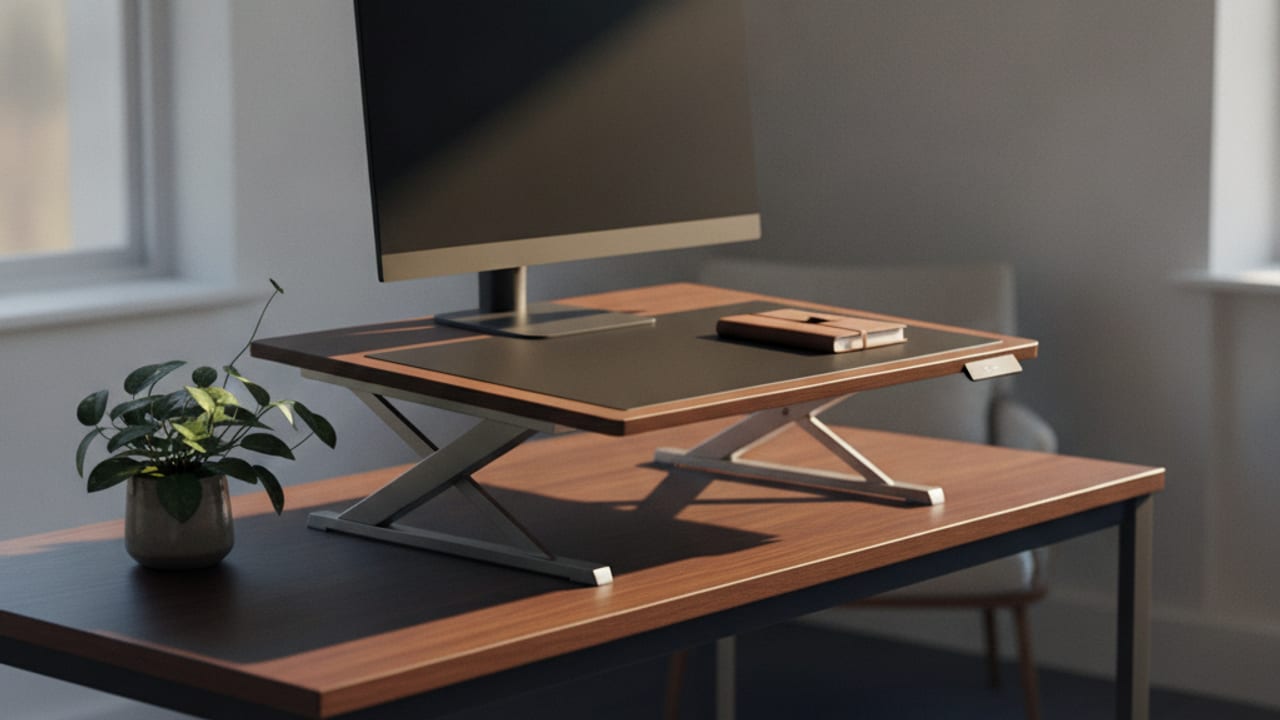
Buy a standing desk converter if you rent, share a desk, like the desk you already own, or want to test standing before committing serious money: good ones typically cost £100 to £180. Buy a full electric standing desk if you work from the same spot most days and can stretch to £200 or more.
That is the short answer, and for most people it really is that simple. But the two options behave quite differently once you live with them, and the differences that matter are not the ones the product listings shout about. This article walks through cost, ergonomics, stability and space honestly, so you can pick once and pick right.
What actually separates the two
A converter is a platform that sits on top of your existing desk. It holds your monitor and keyboard, and rises on a spring assisted or gas strut mechanism when you want to stand, usually by squeezing a lever. Your desk stays where it is, nothing is assembled beyond unboxing, and if you move house the converter comes with you in one piece.
A full standing desk replaces your desk entirely. The whole surface travels up and down, almost always on electric motors in the legs, controlled by buttons on a small keypad. Everything on the desk rises together: monitor, keyboard, coffee, notepad, the lot.
That single difference, whether the whole surface moves or just a platform on top of it, drives every trade off that follows.
What each option costs in the UK
Prices move constantly, so treat these as typical bands rather than quotes.
| Option | Typical UK band | What you get |
|---|---|---|
| Budget converter | £60 to £100 | Basic Z frame or X frame riser, fixed keyboard tray, modest height range |
| Good converter | £100 to £180 | Smooth gas strut lift, wider platform, two tier design with separate keyboard deck |
| Budget electric desk | £150 to £250 | Single motor frame, smaller top, adequate but slower lift |
| Mid range electric desk | £250 to £450 | Dual motor frame, memory presets, better stability at full height, larger tops |
Two things are worth noticing. First, the gap between a good converter and a budget electric desk is smaller than most people expect, often £50 or less. Second, a cheap converter and a cheap desk fail in different ways: a cheap converter wobbles and has a cramped keyboard tray, while a cheap desk mostly just lifts slowly and maxes out at a lower height. If your budget sits right on the boundary, that difference should inform which side you land on.
Already leaning towards a converter? We compared the models genuinely worth buying in the UK right now.
See our best standing desk converters guideThe trade offs that matter day to day
Ergonomics: the converter compromise nobody mentions
A full desk lets you set keyboard height and monitor height independently, because the monitor can go on an arm or a stand while the surface sits exactly at your elbow height. That is proper ergonomics: elbows at roughly 90 degrees, screen top around eye level.
Converters have to compress that geometry into one moving platform. On single tier models the keyboard sits at the same level as the monitor base, which pushes your typing height too high and your screen too low, a double miss. Two tier converters with a separate keyboard deck fix most of this, which is exactly why we favour them, but even then the deck adds a couple of centimetres above the desk surface when you are sitting, raising your typing position slightly for the whole seated day. Tall users also run out of lift on smaller converters: if you are over about six feet, check the maximum platform height before buying anything.
Stability
Physics favours the full desk. A converter is a mechanism balanced on top of furniture, so at full extension there is always some bounce when you type hard, more on cheap X frames, less on good gas strut designs. A decent dual motor desk at standing height is noticeably more planted. If you are heavy handed on a keyboard or you run two large monitors, the full desk carries the load with far less protest.
Space and setup
Here the converter claws back ground. It needs no assembly beyond lifting it out of the box, it makes no permanent claim on the room, and it works in a rented flat, a shared study or on a desk you are sentimental about. A full desk is a piece of furniture: expect 30 to 60 minutes of assembly, a footprint of at least 100 by 60cm, and a socket nearby for the motors. If your working corner doubles as a dining table or your desk lives against original panelling in a rented Victorian terrace, the converter is the answer by default.
The one habit warning that applies to both
Whichever you buy, the failure mode is the same: it becomes a sitting desk with unused potential. Converters make standing a deliberate act, which some people find keeps the habit honest. Electric desks with memory presets make switching so effortless that you do it more often. Neither machine builds the habit for you, but in our experience the one button preset is the feature most likely to keep you actually standing in month six.
Which one should you buy?
- Renting, hot desking or unsure about standing? Converter. It is the reversible, portable, commitment light option, and a good two tier model preserves most of the ergonomic benefit.
- Working from the same home office every day? Full electric desk. The independent keyboard and monitor heights, the stability and the one press presets are worth the extra money over years of daily use.
- Budget capped around £150? Buy a good converter rather than the cheapest electric desk. A £150 converter is a mature product; a £150 desk is built down to a price.
- Over six feet tall? Lean full desk, or check converter maximum heights very carefully. Height range is the spec tall users regret ignoring.
- Two big monitors or a heavy setup? Full desk. Converters list weight limits for a reason, and monitor arms clamp more happily to a proper desktop.
Ready to choose? Our UK guide compares the standing desk converters that actually earn their place on a desk.
Read the best standing desk converters UK guideFrequently asked questions
Is a standing desk converter bad for ergonomics?
Not inherently, but single tier converters force your keyboard and screen to the same level, which compromises both. A two tier converter with a separate keyboard deck gets you close to proper geometry: elbows at about 90 degrees while typing, screen top near eye level. Tall users should check the maximum height before buying, as smaller converters run out of travel above roughly six feet.
Can I put a converter on any desk?
Almost any, provided the desk is deep enough, most converters want around 60cm of depth, and sturdy enough to take 15 to 25kg of converter plus your monitors without flexing. Check your desk does not wobble on its own first; a converter amplifies any instability underneath it.
Are electric standing desks expensive to run?
No. The motors only draw meaningful power for the few seconds the desk is moving, and standby draw is tiny. Even at around 27p per kWh, typical of the 2026 UK price cap, the cost of raising and lowering a desk several times a day works out at pennies per year, not pounds.
Should I stand all day once I have one?
No, and this is the most common mistake. Standing all day just swaps one static posture for another and is hard on feet and knees. The evidence and common guidance point to alternating: start with 15 to 20 minutes of standing per hour and adjust by feel. The win is movement and variety, not standing itself.